Commercial & Office Movers in Augusta, GA
Augusta Georgia Movers handles business relocations around Augusta: offices, professional practices, shops, and warehouses. Work is scheduled around your closed hours rather than through the middle of your week, with what keeps you trading leaving last and arriving first. With the Medical District employing more than 25,000 people, clinics come up often. Send both addresses, the headcount, and the day you need to be running again.
Workplaces we relocate
Offices and professional firms
Law, accounting, finance, marketing, consulting.
Medical, dental, and animal clinics
Where machines and patient files both need gentle care.
Shops and storefronts
Shelving, inventory, displays, and registers.
Warehouses and light industry
Pallet racking, inventory, benches, machinery.
Eateries and professional kitchens
Ovens, prep tables, shelving, and inventory, fitted around service hours instead of crashing through them.
Schools, congregations, and nonprofits
Classrooms, auditoriums, offices, and supply rooms, often planned around a school break.
Moves within a building: one team, one floor, or a new layout
Floors one and two emptied, then restocked after the carpet installers finish.
Server rooms, computers, and records archives
Handled by itself or inside a bigger project.
Moving a household, not a company? Residential moving covers that, and it is planned quite differently.
Lost uptime costs the most
In an office move the truck is seldom the costly part; idle staff are. A commercial move is planned around keeping that downtime as short as it can be, hour by hour.
So the emphasis is order, not speed. Departments the business can't function without are listed first and relocated last, which keeps their downtime minimal. Network hardware typically goes out as the old site closes for good and comes in first at the new one. People who can work from home for a day move early. A large company may stage the move across several trips instead of one big push, trading a few extra loads for far less lost revenue.
Moving day itself doesn't improvise any of this. The plan comes out of touring both buildings first.
Homework for the weeks beforehand
Business relocations that go sideways nearly always trace back to planning gaps:
Have internet and phone service working at the new address before the move.
Setting up service at a new business address often takes much longer than people expect, which is why companies sometimes finish moving and still can't answer phones Monday. Order the day the lease is signed and keep checking on the install date.
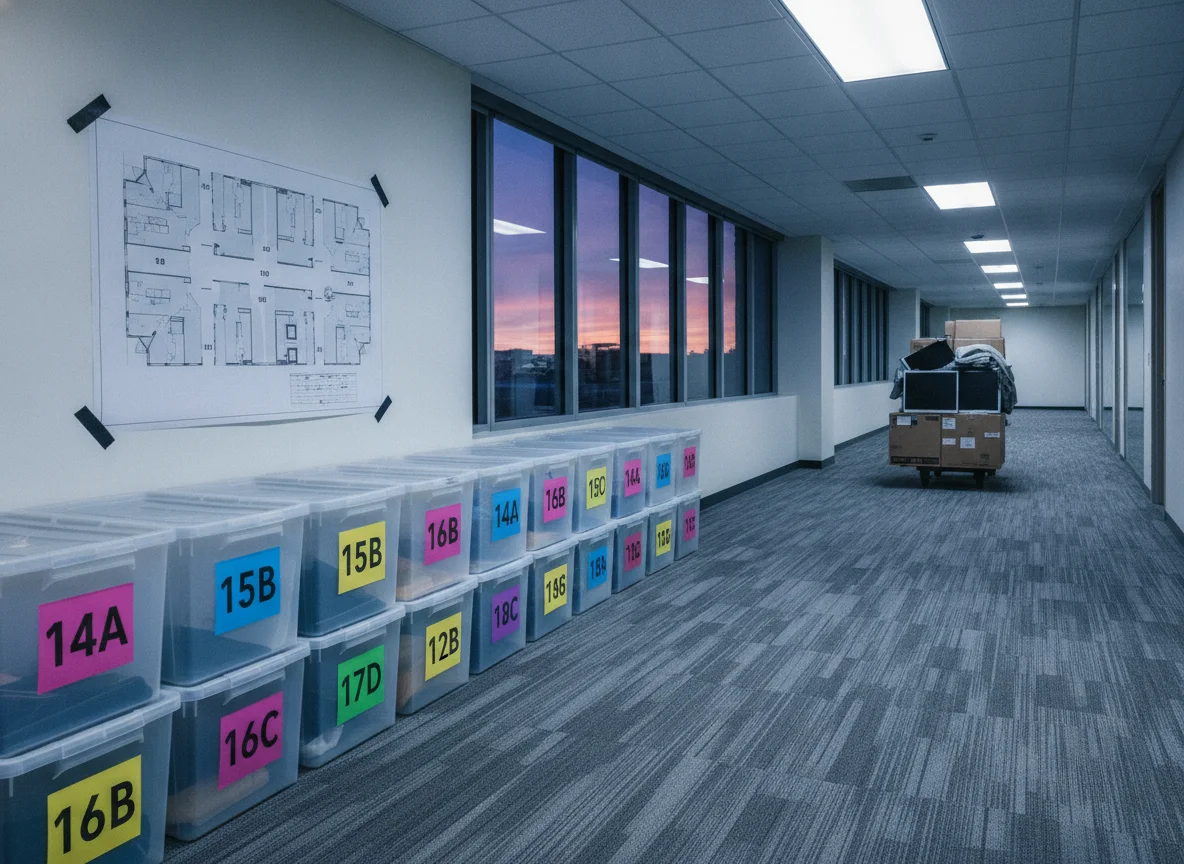
Floor plan of the destination, desks numbered
Every desk, office, and storage area is tagged, so nobody has to decide something in a corridor with others waiting.
A single shared labeling scheme.
Choose a number or a color for each destination room, mark it on all cartons and furniture, and hang the matching plan on the wall at the new site.
A decision-maker at each address.
A person with authority to answer and decide, at the old site and also at the new one.
Employees box their own desks.
Each person gets one crate marked with a name and the new desk number. Personal items and valuables go home with them. Packing yourselves is quicker, and nobody hunts for a stapler later.
Access details on paper.
Who opens, who closes, alarm codes, keys, where crews can park, and the hours the building permits work to happen.
Contact both buildings early.
Landlords often want notice and paperwork before any mover starts, so ask what they need well ahead. For a business license or permits at the new address, Augusta's Planning and Development Department is the office to ask.
Computers, machinery, and items with conditions
Complete a backup before disconnecting a single machine.
Moving hardware always carries a little data risk, and a verified backup takes that risk off the table.
Take photos of the rack's rear and each workstation's rear
Photograph everything before unplugging. Minutes of snapshots spare hours of puzzling.
Bag cables as they come off and label them with their machine
Never one communal box. Screens go upright in fitted cartons and tower cases get their own box.
Network gear and servers are powered down and brought back by your IT contractor or a specialist
That person powers systems off correctly and restores them in the right order. Movers carry the hardware; configuration is a separate job and shouldn't count as part of the move.
Check the lease on every copier and multifunction printer before anyone touches it.
Many leased copiers must be moved by the lessor's own service person; shifting one yourself could break the contract or end maintenance coverage. Schedule that apart from the main move.
Vaults, fire safes, and very heavy fixtures
Expect to need proper equipment and extra hands, plus occasionally an engineer's word on whether the new floor can bear the weight. Mention these early.
Lab, clinic, dental chair, commercial oven, or gym machinery —
Often governed by manufacturer or vendor rules on how it gets disconnected, shipped, and calibrated again. When that's the case, the vendor does that part, not the movers.
Cubicles, desks, and partitions
Modular cubicle walls and partitions can come apart and be put back together, though a system is rarely compatible with any other. Panels, connectors, and fasteners are made for one product line, and a plan that worked in the former office may not translate to the new floor shape. Work out what you own and what the new layout accepts before counting on the whole thing coming across.
Sit-stand desks, conference tables, filing cabinets, and shelving units also break down and rebuild. Hardware is bagged and tied to its parent piece every time, because a partition missing its brackets is scrap metal.
Confidential files and records
Case files, personnel folders, and medical or financial documents travel sealed and numbered, with a count taken at each end so nothing is left alone or turns up unexplained. When regulations cover your records, learn the rules first and raise them before the move; that conversation belongs in planning, not on the day, and it keeps surprises off the schedule.
Anything too sensitive to leave your sight should ride along with one of your own employees, not on the truck.
Giving the old suite back to the landlord
Leases frequently say the space must come back in a defined state, which people overlook until the final week. Built-in shelving, wall brackets, signs, and wiring are the usual items to remove, and anything left over needs somewhere to go. Old furniture, dead IT equipment, and archives staying behind each require their own disposal arrangement.
Mention it while planning. Given time it's easy; left to the final days it turns costly.
What shapes the cost
What it adds up to depends on the volume, how much furniture gets taken apart and rebuilt, how much IT and special equipment is in play, how awkward either building is for loading, whether the job is one visit or several, whether it falls within or outside your hours of operation, and how much old space must be emptied. To keep some tasks in-house, loading and unloading help supplies the lifting while your staff handle the rest.
Includes Country Club Hills, Fairview Gardens, Belvedere, Clearwater, Beech Island, North Augusta, and the rest of Augusta, home to 202,071 people.
Quick answers
Must operations stop?
Often. Staged relocations, or ones scheduled around your hours, exist so a company can keep working. Expect extra planning and sometimes additional trips; most owners judge the effort worthwhile.
Who unplugs the computers?
The shutdown, the network, and the restart belong to your IT provider or a specialist. Movers carry the equipment itself. Settle in advance who owns which step, since "I figured you were handling that" can cost a business an entire morning of work, or more.
What's the right lead time for a business move?
Earlier than for a house, and the truck isn't the bottleneck. Internet service, building approvals, and vendor-handled equipment run on schedules you can't control, so begin all three once the new address is firm.
Does packing come as an add-on?
Yes. Packing services can take on the whole workplace or just the awkward parts, like a records room or break-room kitchen. Typically employees pack desks themselves and everything else goes to the packers.
Planning a business move?
Send both addresses, the number of people and desks involved, your target date, and unusual items like servers, a safe, clinical or lab equipment, or a leased copier. A tour of both buildings is what converts all of this into a schedule.